New Balance + AlterVision: How to Measure the Brick-and-Mortar Store Funnel Hour by Hour
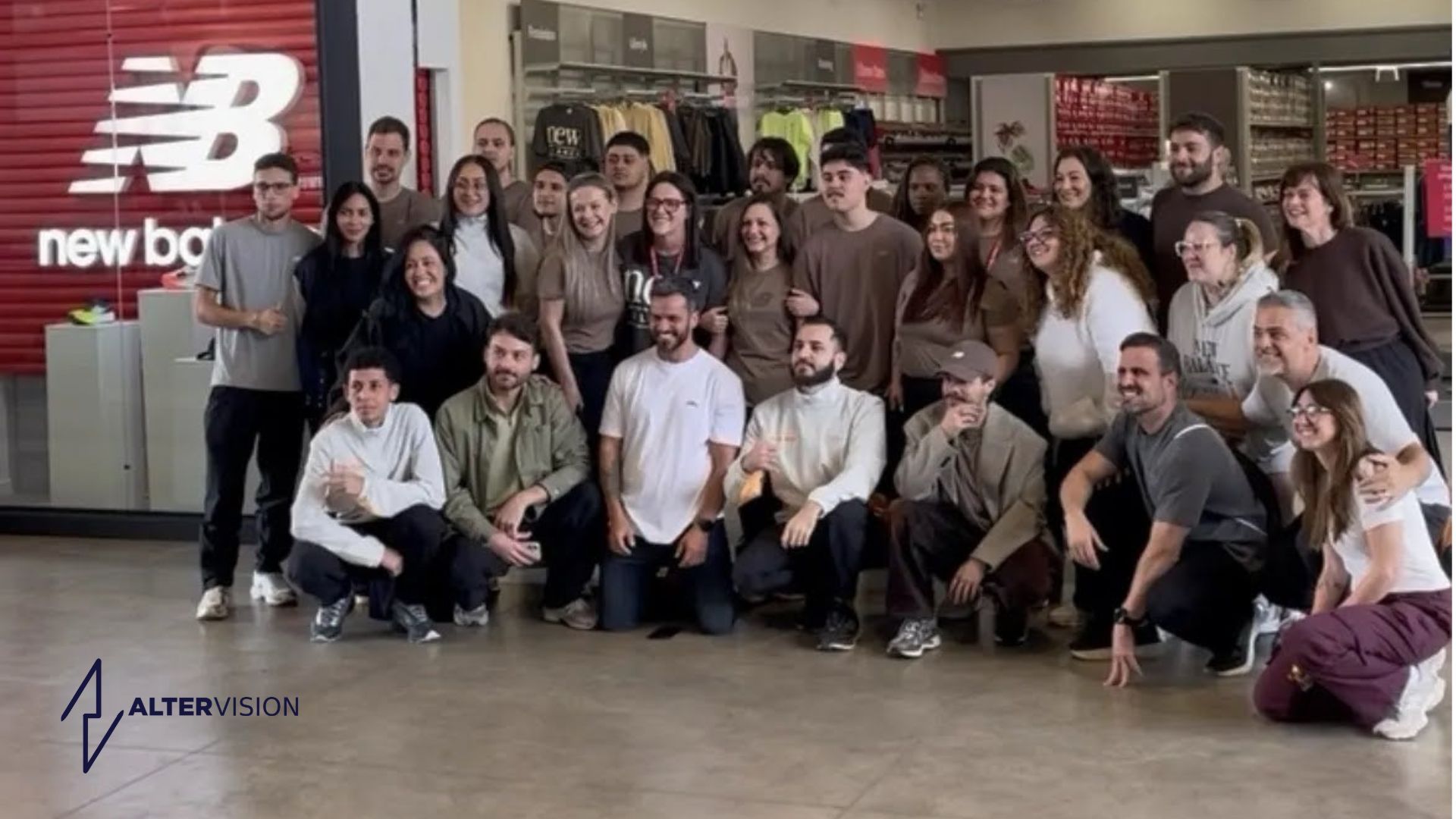
In short: New Balance, operated in Brazil by Grupo Dass, uses the AlterVision platform to measure the funnel of its physical stores (passersby, visitors, and buyers) and to track foot traffic, capture rate, and conversion rate hour by hour, with targets set for each hour. Foot traffic counting goes live on each store's first day, as it did at the New Balance store opening in Novo Hamburgo, Brazil. Deployment uses the store's existing cameras and is calibrated remotely by the AlterVision team.
Why does brick-and-mortar retail need to measure the store funnel?
Because most sales still happen in physical stores, yet that is where retailers have the least data. In 2025, online sales in Brazil were equivalent to 6.5% of brick-and-mortar retail revenue, according to a FecomercioSP survey: for every R$100 sold in stores, R$6.50 was sold online.
On a website, retailers know where each visitor came from, how many pages they viewed, and at which step they abandoned their cart. In stores, most chains only measure the final outcome: revenue, average ticket, and units per transaction. Without the steps that come before the sale, a revenue drop turns into a matter of opinion. The store manager says traffic was slow or that customers were "just browsing," and no one can confirm it.
What is the brick-and-mortar store funnel?
The physical store funnel has three measurable stages, following the same logic as e-commerce:
-
Passersby: people who walk past the store. They are the equivalent of ad impressions.
-
Visitors: people who walk in. Visitors ÷ passersby = capture rate, which shows whether the storefront and window displays are working.
-
Buyers: people who make a purchase. Transactions ÷ visitors = conversion rate, which shows how effective the sales floor is.
Example: a store with 2,000 passersby, 300 visitors, and 60 transactions in a day has a 15% capture rate and a 20% conversion rate. If revenue drops, these two metrics show at which stage the customer was lost.
Why measure by the hour instead of by the month?
A monthly report explains the month that already passed. Hourly tracking lets you act the same day. With hourly targets, the question shifts from "why did the month close below target?" to "why is this store below target right now?"
• Few people came in: the problem is outside the store (window displays, storefront, mall traffic).
• People came in but didn't buy: the problem is in customer service, staffing, or product.
How does New Balance measure its stores with AlterVision?
New Balance tracks each store's performance hour by hour on the AlterVision platform, with targets set for every hour. Before switching, the operation already had a foot traffic counter but couldn't get value out of it. Before, with the previous vendor:
• Hard-to-access platform and weak reports, even with a Tableau integration
• Information didn't arrive when the team needed it
• No capture rate metric
• No way to pinpoint the stage where customers were lost
With AlterVision:
• Platform "right at hand," checked throughout the day
• Hourly targets and metrics
• Foot traffic, conversion rate, and capture rate
• Store below target: the team checks traffic, capture rate, and conversion for that hour
"It made a big difference in our day-to-day dynamics. We're much more agile now with the platform right at hand," says New Balance. For the brand, the culture of tracking KPIs was already in place. What AlterVision added was speed.
How did the rollout go at the New Balance store opening in Novo Hamburgo?
AlterVision's foot traffic counting went live on the very first day of the New Balance store in Novo Hamburgo, in southern Brazil, even though it was a reopening in a market where the brand already operated. For Luciana Passeti, Operations Manager at Grupo Dass, delivering a beautiful store isn't enough: you need to understand the customer experience from opening day.
"I think it's super important that right from day one we start with foot traffic counting, so we always have our conversion and average ticket metrics," Luciana says. The request has become routine with AlterVision's projects team. "I joke with Lucas and tell him: 'Lucas, don't forget to activate my store on day one,'" Luciana says. According to her, opening-day data sets the store's baseline: "It's essential for us to understand what we expect from the store going forward."
Three factors explain the speed:
• Existing cameras: in stores that already have cameras, deployment is "almost plug and play," according to New Balance.
• Remote calibration: the AlterVision team checks counting accuracy and camera angles online.
• Support: "We were really surprised by how agile and fast it was," the brand says.
"It's extremely important for the business that we have these highly accurate numbers, which Alter always delivers for us," adds Luciana Passeti.
What's next: understanding why conversion drops
With the funnel measured, New Balance is now investigating root causes: why a store's conversion rate is lower at a given hour. With AlterVez, AlterVision's sales floor queue management tool, the analysis reaches the individual sales associate: who converts the most and who needs support. The plan is to cross this data with service quality and stockouts.
The result is less guesswork. When a manager blames a drop on low traffic or on customers who were "just looking," the numbers show whether that impression holds up. Action can then target customer service, training, product mix, or sales strategy.
"Not having a conversion rate is kind of like sailing in the dark," the brand sums up.
What the New Balance case shows for brick-and-mortar retail
• Full funnel: physical stores can be measured like e-commerce, with passersby, visitors, and buyers, plus capture rate and conversion rate.
• From day one: activating foot traffic counting at opening creates the store's baseline.
• Hourly rhythm: hourly targets and metrics let you course-correct while there are still sales to be made.
• Pinpointed causes: crossing conversion with associate performance, service quality, and stockouts shows where to act.
For New Balance, measuring the store funnel has become a basic management requirement: "If you're not measuring this data, you're really operating in the dark." Want to measure your store funnel like New Balance? Talk to AlterVision.
Frequently asked questions
Which company handles foot traffic counting for New Balance stores in Brazil? AlterVision. New Balance, operated in Brazil by Grupo Dass, uses the AlterVision platform to count foot traffic and track capture rate and conversion rate in its stores hour by hour.
What is capture rate in retail? It is the ratio of visitors to passersby. A store with 2,000 passersby and 300 visitors has a 15% capture rate. This metric shows whether the storefront and window displays are drawing customers in.
How do you calculate a physical store's conversion rate? Divide the number of transactions by the number of visitors. With 60 transactions and 300 visitors, the conversion rate is 20%.
Do you need to install new cameras to use AlterVision? Not always. In New Balance stores that already had cameras, deployment was "almost plug and play," with accuracy and camera angle calibration done remotely by the AlterVision team.
When should you activate foot traffic counting in a new store? On day one. At the New Balance store opening in Novo Hamburgo, counting went live at opening to set the baseline for what to expect from the store going forward.